
Introduction
A last name, often reflecting a trade, place, or trait, carries familial history, as seen in recognizable surnames like Smith, Garcia, and Müller. This surname generator provides over a thousand real, documented last names from twenty-one cultures, allowing writers to select authentic surnames rather than inventing plausible-sounding ones.
Anyone who’s stared at a blank character sheet, or an empty box on a book cover where the author’s name is supposed to go, knows this particular kind of stuck. A last name generator fixes it fast. But the useful ones go a step further and explain why a name works in the first place, and that’s really what this page is trying to do.
How to Use This Last Name Generator
Nobody needs instructions for this. Hit generate, get a batch of names, done. The filters underneath are where things get interesting, though.
Step 1 :
Origin chips narrow the pool down to a single culture or several stacked together. English, Japanese, Nigerian, Arabic, eighteen more besides. The “Formed by” filter sorts by how a name was actually earned: occupational, patronymic, topographic, descriptive, or ancestral (more on what those mean in a second). There are begins-with and ends-in fields for anyone chasing a specific sound, which comes up more often than people expect, usually when trying to match a sibling character or hit a certain rhythm.
Step 2 :
Then there’s the pairing feature. Typing in a first name shows the full name live on every card, which settles one of the most common questions behind a last name generator based on first name searches: does this actually sound right together, or does it fall flat the second it’s said out loud? A rarity tag (Common, Uncommon, Rare) sits next to each result too, and it matters more than it looks like it should. Giving a lead character and a background extra the same naming weight is a small thing, but readers notice small things.
Step 3 :
Favorites save for later. Results don’t repeat inside a session until the whole filtered pool has cycled through once. And because everything in the database is a verified surname, the meaning attached to each name is real, not something generated to sound plausible in the moment. That last part matters more than it seems like it should, and it comes up again further down.
Where Do Last Names Actually Come From? A Short History
For most of human history, one name did the job. Villages were small. “Thomas” was enough. Surnames only became necessary once populations outgrew the ability of everyone to just know everyone else, surnames appeared at vastly different times in different cultures and in England, they weren’t legally required until sometime between the 13th and 15th centuries. Mostly because the Crown wanted a way to track who owed what in taxes. Not exactly romantic. Similar shifts happened across Europe and Asia on roughly the same timeline, and bureaucracy gets most of the credit, not tradition.
That dull, practical origin is exactly why surnames end up so information-dense. Nobody sat down and picked one the way a first name gets picked. It accumulated. Someone who worked metal became a Smith without really trying. Someone who lived near a hill became a Hill. A last name generator built on that kind of history isn’t producing noise. It’s surfacing small, real leftovers from someone’s actual life, one click at a time.
A few numbers, since they’re worth knowing: Wang (王) is generally considered the most common surname on Earth, shared by more than 100 million people in China alone, which is roughly the combined population of Germany and France. The US alone has well over 150,000 distinct surnames on record. Smith has held the top spot in English-speaking countries for centuries, mostly because metalworking was essential everywhere, which made it the default trade, and by extension the default surname, for an enormous slice of the population.
This is also why a last name generator built on real records tends to age better than one built on guesswork. History already sorted out which combinations of sound and meaning turned into actual surnames and which never caught on. No need to reinvent that.
The Five Types of Surnames, Explained
Nearly every surname that exists, in nearly every language, falls into one of five buckets. Once that clicks, a last name generator stops being a party trick and starts being genuinely useful, because knowing why a name exists makes it a lot easier to choose one on purpose instead of by accident.
Occupational Surnames
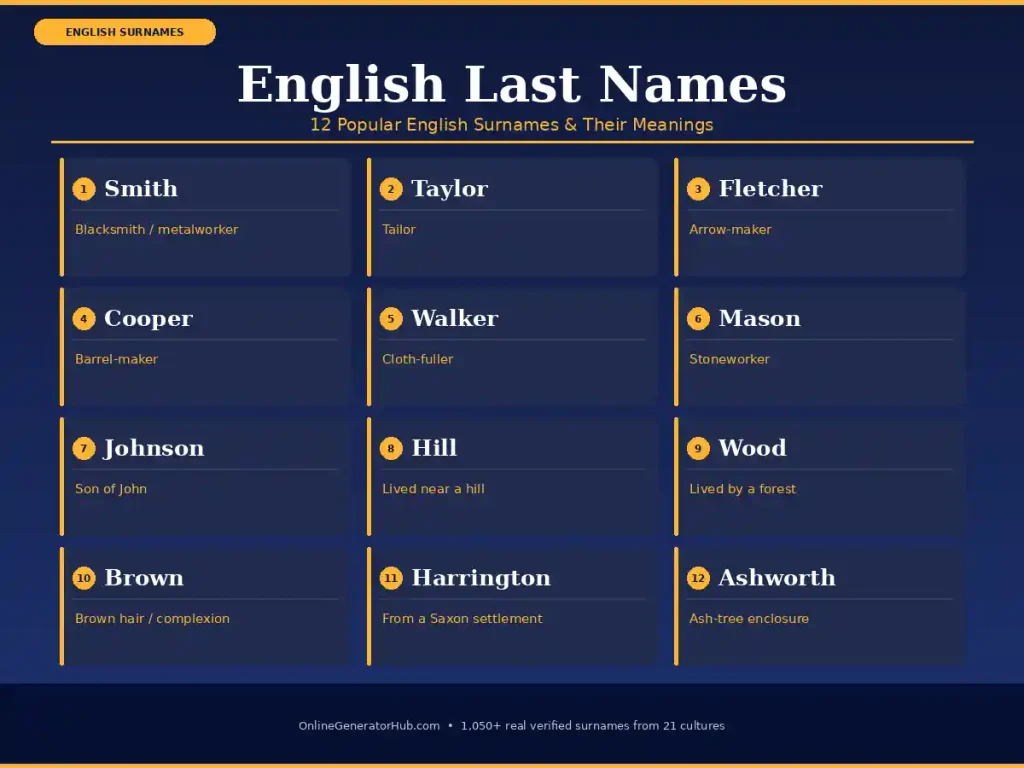
Straight from a trade or craft. Smith (blacksmith), Cooper (barrel-maker), Fletcher (arrow-maker): the usual English suspects. Same logic, different language: Müller is German for miller, Ferreira is Portuguese for blacksmith. These suit grounded, working characters, or any setting where a person’s trade basically was their whole identity.
Patronymic Surnames
Built from a father’s given name. Johnson is, literally, “son of John.”A patronymic is a name derived from that of a father or paternal ancestor, usually by the addition of a suffix or prefix meaning ‘son.’ The pattern shows up everywhere: O’Brien means “descendant of Brian” in Irish, González means “son of Gonzalo” in Spanish, Eriksson means “son of Erik” in the old Scandinavian style. It’s probably why so many of the most common surnames worldwide are patronymic. The logic is nearly universal.
Topographic Surnames
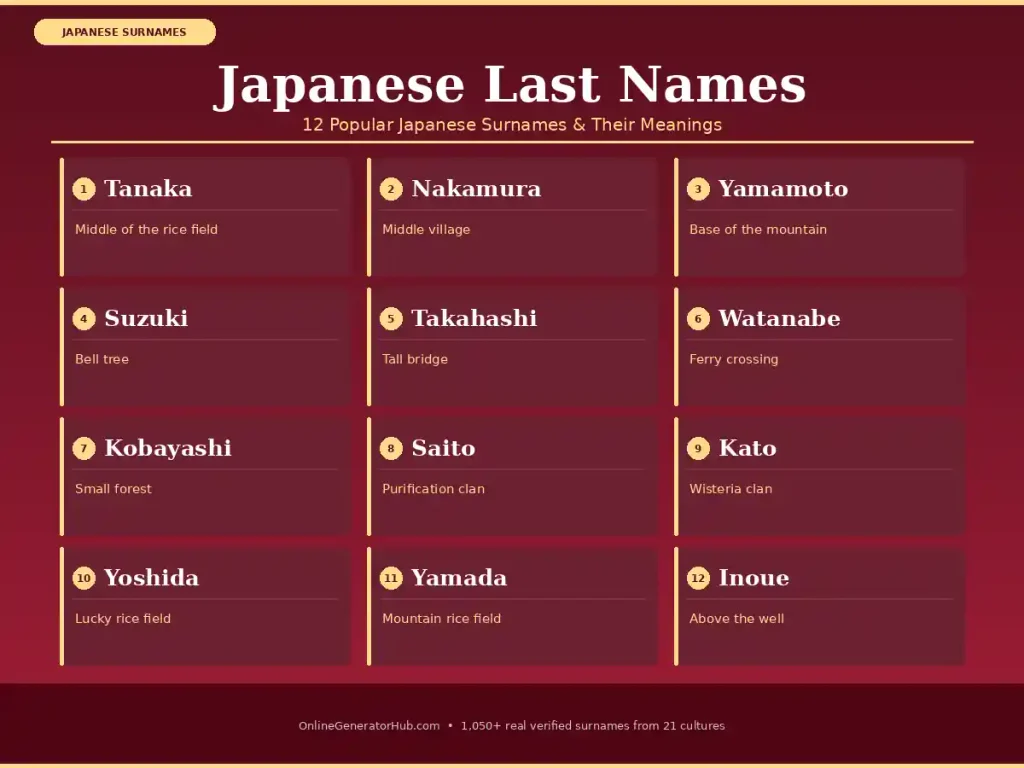
Landscape and geography, basically. Hill, Brook, Wood, obvious enough in English. Yamamoto means “base of the mountain” in Japanese; Berg is just German for mountain. Names like this feel grounded and specific, which is handy for a character who’s tied tightly to one particular place.
Descriptive Surnames
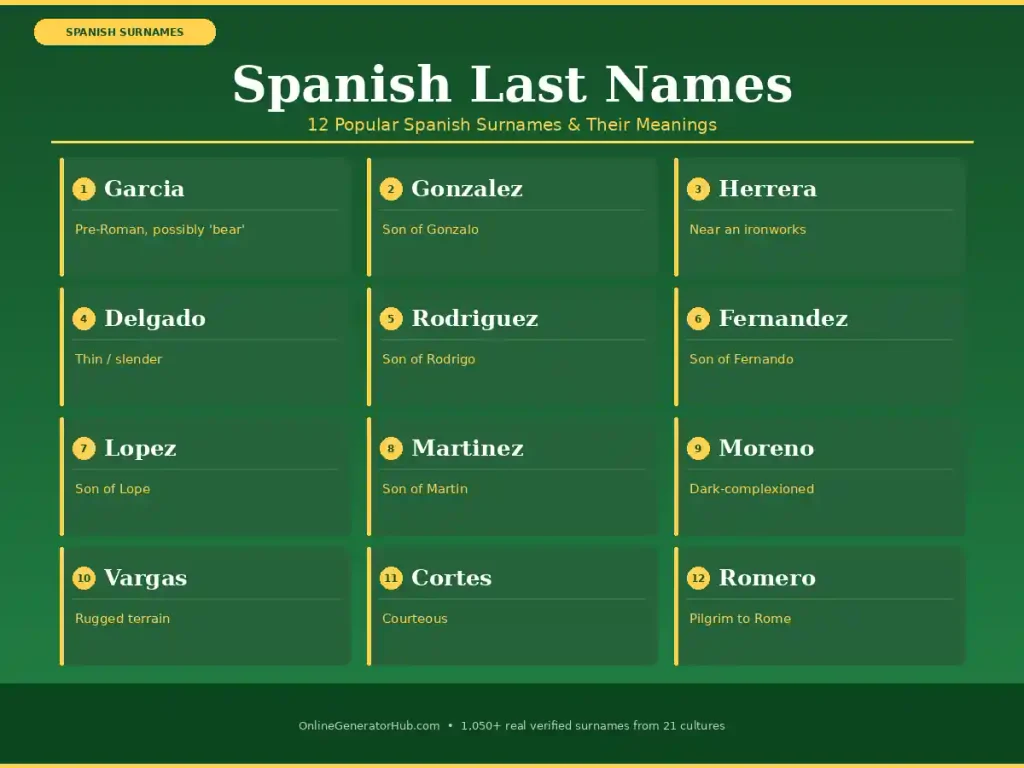
A physical trait or personality quirk that stuck around long enough to become hereditary. Brown and Young in English. Moreno (“dark-complexioned”) in Spanish. Petit (“small”) in French. Probably the most colorful of the five categories, and useful for hinting at characterization without spelling anything out directly. Descriptive surnames are especially useful for antagonists — pair one with our villain name generator for a character name that hints at personality without spelling it out.”
Ancestral Surnames
Points to a clan, a title, or a lineage rather than one job or one trait. Morgan comes from an old Welsh name meaning “sea-born.” Reddy was a South Indian chieftain’s title. Sato traces back to an old Japanese clan name. There’s often a weight of history or status packed into these that the other four categories just don’t carry.
Every name in this last name generator gets tagged with one of these five categories. Filtering by type is really filtering by the story behind a name, which is a different thing entirely from filtering by sound.
Browse Real Last Names by Origin and Culture
A lot of the searches around a last name generator are for one specific culture. People look for a last name generator English writers can trust, a last name generator Japanese fans will find accurate, a last name generator German history buffs might use for a period piece. This tool covers all of it, fifty real surnames per origin across twenty-one of them. A small sample:
- English: Ashworth, Whitfield, Harrington, Fletcher
- Irish: O’Brien, Kavanagh, Gallagher, Doyle
- Scottish: MacDonald, Buchanan, Sinclair, Munro
- Italian: Castellano, Marchetti, Bellini, Ferrari
- French: Beaumont, Moreau, Lefevre, Fournier
- German: Albrecht, Hoffmann, Schreiber, Vogel
- Spanish: Delgado, Herrera, Salazar, Vargas
- Japanese: Takahashi, Nakamura, Fujimoto, Sakamoto. Use our Japanese name generator to create best Japanese names.
- Chinese: Wang, Li, Zhang, Chen
- Korean: Kim, Park, Choi, Han. Our Korean name generator generates authentic given names in Hangul with meanings.
- Indian: Sharma, Nair, Rao, Kapoor
- Arabic: Al-Rashid, Haddad, Mansour, Karimi
- West African: Okafor, Adeyemi, Mensah, Diallo
- Nordic: Lindqvist, Bergström, Eriksson, Solberg
- Fantasy: Ravenshade, Ironvale, Stormrider, Duskbane
That last row gets its own mention because a fantasy last name generator is one of the more frequent related searches out there. The invented names in this category still follow the same five patterns real surnames do, mostly topographic and descriptive roots, so they land as earned rather than random even though no historical family ever actually carried one.
How to Choose the Right Last Name for a Character or Project
Generating a batch is the easy part. Picking one out of it takes a little more thought.
Origin should match the setting, first. A first and last name pulled from the same culture just reads right together. Mixing origins without a reason baked into the plot- an adoption, a marriage, an immigration story- tends to leave readers a bit puzzled about who they’re even reading about.
Say it out loud. Sounds obvious, but rhythm problems, accidental rhymes, awkward consonant pileups all get caught by the ear way before they get caught by the eye.
Rarity is a tool, not an accident. A common surname works fine for a background character or an everyman lead. A rare one pulls focus, which is exactly what a protagonist or a standout villain usually needs.
If you’re also shaping how a character’s full name looks on a cover or title card, our stylish name generator can help you find a style that fits the tone.”
Place after: “And it’s worth a quick search before locking anything in…”
Meaning can do quiet work if it’s not overdone. A surname that happens to translate to “wolf” for a fierce character, or “smith” for someone who literally builds things, rewards a reader who’s paying attention without hitting them over the head with it.
And it’s worth a quick search before locking anything in, just to make sure the full name doesn’t accidentally belong to someone real and identifiable already.
Popular Ways People Use a Last Name Generator
Naming a novel’s hero is just one use among many, and honestly it might not even be the most common one. Novelists and short-story writers use a last name generator to keep an entire cast from accidentally sounding alike. Screenwriters need names that survive being said out loud, since dialogue exposes an awkward surname almost instantly.
Tabletop players rolling up a new D&D or Pathfinder character reach for one to give a backstory some actual weight. Game masters building a campaign villain can combine a result here with our villain name generator to get a full name with the right weight and menace.”Authors picking a pen name are shaping how a reader sees them before a single page gets opened, and the right origin and rarity level do a surprising amount of that work quietly.
Then there’s the simpler reason people show up: plain curiosity about what their own surname means, or a friend’s. And worldbuilders lean on a generator like this to keep naming consistent across an entire invented culture, which is a lot harder to fake than it sounds.
Why This Generator Uses Real Surnames Instead of AI-Invented Ones
A lot of surname tools run on AI now, which means they can spit out names forever without running dry. The problem is an AI can just as easily invent a surname that doesn’t exist anywhere and bolt on a meaning that isn’t real, and there’s no obvious way to tell a genuine etymology from a confident-sounding guess.
This one goes the other direction. Every surname comes from a curated, verified database, and every meaning attached to it is accurate rather than produced on demand. The honest trade-off is scale. Fifty names per origin is a lot, but it’s not the fake-infinite number an AI-powered last name generator can pretend to offer. For anyone who actually cares whether a “meaning” is real, that trade is an easy one to make.
Last Names by the Numbers
A few facts, good for trivia night or just idle curiosity:
- 100 million+ people share the surname Wang, the most common last name on Earth.
- 150,000+ distinct surnames are estimated to exist in the US alone.
- 14th century, roughly when England made hereditary surnames a legal requirement.
- 1,050+ real, verified surnames live inside this generator, spread across twenty-one origins.
Frequently Asked Questions
What is a good rare last name?
Usually one with a low popularity ranking back in its country of origin: a distinctive occupational or ancestral name rather than a common patronymic like Johnson or Smith. Ashworth (English), Colquhoun (Scottish), and Angelopoulos (Greek) all fit that description. This generator tags names as Common, Uncommon, or Rare, so filtering for the distinctive end takes one click, not a research project.
How do you create your own last name?
Legally, that’s a formal name-change process, and the exact steps depend on where someone lives. Creatively, for a character or a pen name or a whole fictional world, it’s easier to just borrow the five real patterns: pick a trade for occupational, a father’s name for patronymic, a landscape feature for topographic, a trait for descriptive, a lineage for ancestral. Shape it so it fits the sound of whatever language it’s meant to belong to, and it’ll land.
What’s a good name for a last name?
Depends entirely on the context. Realistic fiction wants a name matching the character’s culture and era. A pen name wants something short and easy to say out loud. Fantasy or game characters usually do better with an invented name built on real patterns, like the fantasy category here, than with a random pile of syllables that just sounds vaguely medieval.
Is it possible to create a last name?
Yes, both legally and creatively. Legally, most countries allow a name change through official channels, though the process varies a lot by jurisdiction. Creatively, building a surname just means following the same patterns that produced real ones centuries ago, which is exactly what the fantasy category on this page is doing behind the scenes.
Are the surnames in this generator real?
Yes, aside from the ones specifically labeled fantasy. Every other name comes from a documented, real-world surname with a meaning and origin that’s been verified, not guessed at by an algorithm.
Can generated last names be used commercially?
Surnames aren’t copyrighted, so anything here is free to use in a novel, a game, a screenplay, whatever. The one thing worth checking is whether a full name lands too close to a real, living public figure.
Does this last name generator work with a first name?
Yes — type one into the pairing field and the full name shows up live on every card, which makes it much easier to hear how the rhythm and origin actually sit together before committing.
How many surnames does this last name generator include?
1,050 real, verified surnames, fifty per origin across twenty-one cultures, plus a fantasy category built for invented worldbuilding names. Every single entry carries its origin, its type, and a rarity rating.
Final Thoughts
A last name is never just a label. It’s a small scrap of inherited history, whether it belongs to someone real or a character who didn’t exist ten minutes ago. This generator was built around that idea: real surnames, sourced honestly, organized by the same five patterns that produced actual family names for centuries, and searchable by origin, meaning, and rarity instead of pure guesswork. Naming a protagonist, rolling up a new character sheet, picking a pen name, or just chasing down what a name actually means. Whatever brought someone to this last name generator, the tool above is ready, and it’ll keep turning up real results for as long as there are names left to give out.