What is DnD Name Generator?
A DnD name generator builds Dungeons & Dragons character names by following the sounds and structures each race actually uses, instead of stringing together random fantasy syllables. Thandor Ironfoundry. Sylvaeril Moonwhisper. Verthisathurgiesh Kepeshkmolik. None of those got picked at random. Each follows a pattern tied to its race: hard consonants for Dwarves, soft, flowing sounds for Elves, and a clan name that comes before the personal name for Dragonborn. A good DnD name generator respects those patterns instead of ignoring them, which is exactly what the tool above does across twelve player races. No shortcuts, no shared syllable pile everyone draws from equally.
Anyone who’s sat at a table on session zero, staring at a blank character sheet with no name yet, knows how much that one missing detail can stall an otherwise finished character. A DnD name generator fixes that in seconds. The better ones go further and explain a little of the logic behind the name too, since that logic is most of what makes a result feel like it belongs to a race instead of just sounding vaguely medieval.
Most tools in this space fall into one of two camps. Some run everything through an AI prompt, flexible but inconsistent from one roll to the next. Others pull from a fixed list that never adapts to the race actually selected. This one sits somewhere more deliberate: rule-based, race-specific, made to behave the same way every time it gets rolled. Doesn’t sound like a big deal until a whole
How to Use This DnD Name Generator
Using it comes down to three choices: pick a race, set a couple of preferences, roll. The race chip drives almost everything else, because each of the twelve pulls from its own naming structure rather than one shared pool.
STEP 1:
Race selection sits at the top: Human, Elf, Dwarf, Halfling, Dragonborn, Tiefling, Half-Orc, Gnome, Half-Elf, Orc, Tabaxi, Goliath. Gender narrows the first-name pool to male, female, or either. The surname toggle is where it gets interesting, because “surname” doesn’t mean the same thing for every race here.
Turn it on for a Dragonborn and the clan name shows up first, ahead of the personal name, matching how Dragonborn actually introduce themselves. Turn it on for a Goliath, and the result carries a birth name, an earned nickname in quotes, and a clan name, all three at once. Turn it on for a Tabaxi and no surname shows up at all, because Tabaxi don’t really use one. They get a short descriptive phrase instead, generated automatically regardless of the toggle
STEP 2:
A slider sets how many names come back per roll. Every card can be saved to favorites or copied to the clipboard, and favorites persist in the browser between visits, so there’s no need to screenshot a good result before it scrolls off the page.
STEP 3:
No account, no prompt to write, no waiting on an AI response. Pick a race, adjust two or three settings, roll. Built to be used mid-session by a Dungeon Master who has about three seconds before the table notices the pause, not just by a player planning a character weeks ahead of time. That’s a meaningfully different design goal than most of the DnD name generator tools currently online, which tend to assume plenty of spare time and no pressure to move a scene along.
Where D&D Naming Conventions Actually Come From
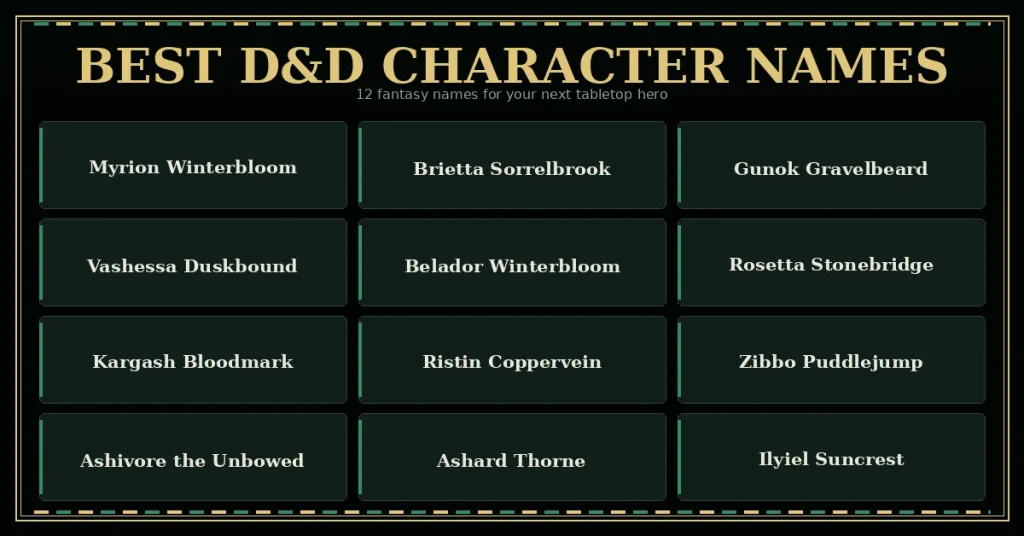
D&D naming conventions trace back to the game’s earliest design, which leaned hard on Tolkien-style fantasy linguistics, older mythology, and pulp adventure fiction, then handed each race its own distinct sound instead of one shared naming pool. Dungeons & Dragons was created by Gary Gygax and Dave Arneson and first published in 1974. Fifth edition, usually just called 5e, is the ruleset most tables play today, and it’s the edition this generator’s race list is shaped around.
Dwarf and Elf names don’t sound anything alike, and that’s not an accident. Same instinct that shapes real-world naming: culture bleeds into sound. Dwarves get blunt, guttural names because their in-world culture centers on stone, metal, endurance. Elves get soft, melodic names tied to long lives and a closer relationship with the natural world. None of that is arbitrary flavor text. It’s baked directly into how each race’s name bank here was actually put together, and it’s the same reasoning that separates a decent DnD name generator from one that just recombines generic fantasy syllables without any regard for which race they’re supposedly attached to.
How Naming Conventions Differ by Race
Naming conventions differ by race because each one in this generator carries its own phonetic identity, not a shared generic list. Pick a different race, and it isn’t just cosmetic.
Human
Flexible. Humans in most settings borrow from every culture at once, so nearly any combination sounds plausible. Easiest starting point for a first-timer who just wants something that reads as normal at the table.
Elf
Soft, liquid sounds. Lots of l, r, n, v, usually landing on an open vowel at the end. Family names lean on the natural world: moonlight, starlight, a particular tree. Fits a people who measure time in centuries.
Dwarf
Short and blunt. K, g, th sounds doing most of the work. Clan names are compound words built from stone, metal, craft, the kind of name that sounds hammered rather than spoken.
Halfling
Cheerful first names, warm domestic surnames. Hearth, food, home, over and over. A naming style for a people who prize comfort over grandeur.
Dragonborn
Clan name first, personal name second, the reverse of what most players expect coming from a Human background. Sounds lean toward hard stops and long vowels, built for a voice meant to carry across a battlefield.
Half-Orc
A blend, structurally. Human-style shape with a harder consonant dropped somewhere in the middle, usually toward the front of the name, which keeps it readable while still marking it apart from a purely Human result.
Gnome
Playful, bouncy, often three syllables where other races would use two. Gnomes traditionally pick up a nickname from other people long before choosing one for themselves, which shows up here as a slightly chaotic-sounding first name paired with something more grounded.
Tiefling
Often chosen rather than inherited. Some names lean abstract, some carry a darker or infernal edge, and both fit a race whose relationship with its own ancestry tends to be complicated on purpose.
Goliath
Three parts at once: a birth name chosen for a virtue, a nickname earned through an actual deed, and a clan name inherited from birth. Introduce a Goliath properly, and it’s basically a life story in one sentence.
Tabaxi
No surname. A short descriptive phrase instead, built around a trait, a memory, a habit. Identity treated as something earned moment to moment rather than handed down.
Every one of these patterns lives inside the generator above, so switching the race chip changes more than sound. It changes the entire structure the name follows. One gap to flag honestly: races like Owlin, added more recently through supplements such as Strixhaven, aren’t part of the current twelve. If a specific race is missing, the generator’s D&D Beyond species page is a solid place to check whether it’s an official option before homebrewing one.
How to Choose the Right Name for a Character
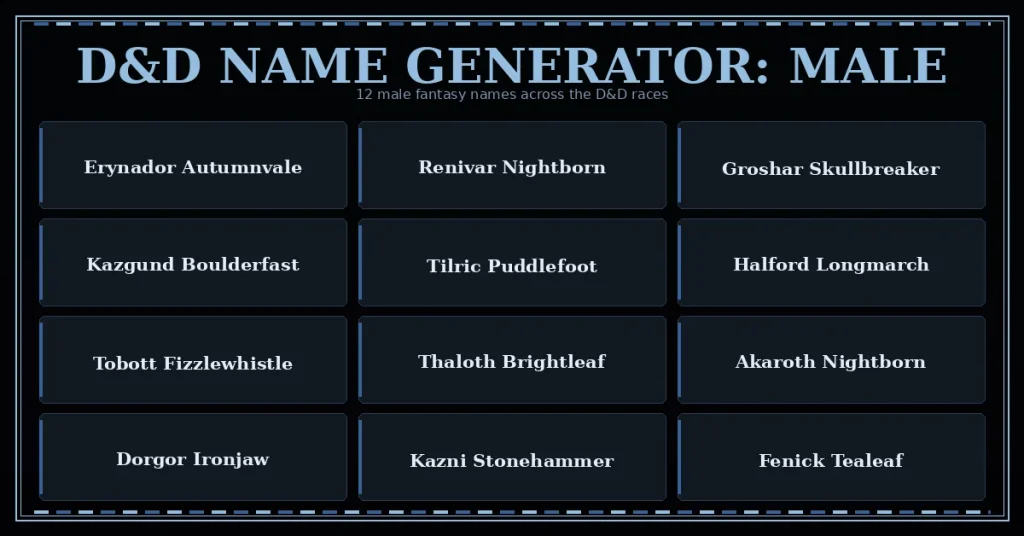
Choosing the right name comes down to matching sound and structure to race, class, and tone, then testing it out loud before locking it in. Rolling a batch here is the easy part. Picking the one that fits takes a little more thought.
Race and class should line up loosely. A solemn Paladin and a quick-tongued Rogue can both be Human, but the name picked for each should hint at which is which before a line of dialogue gets spoken. Say it out loud. Sounds obvious, but a name that’s awkward to say gets shortened by the table within two sessions no matter what’s written on the sheet.
The surname toggle is worth using on purpose rather than by default. A bare first name reads younger, humbler. A full clan name or an earned nickname reads more storied. A “noble” character concept in particular benefits from the surname toggle switched on, since a full formal name with a clan or family attached is usually what signals status at a table, more than any single fancy-sounding syllable ever does on its own.
Backstory or alignment can nudge word choice without needing to be heavy-handed about it. A Chaotic Evil Tiefling doesn’t need a name that literally translates to “gentle light,” even if nothing forces that connection. And it helps to double-check that a generated name doesn’t already belong to a well-known published NPC or deity in whatever setting is being played. That kind of overlap confuses fast.
For characters who need more than a name to feel finished, pairing a rolled result with something like a random character trait generator tends to fill in the rest of the picture quickly, giving a personality quirk or two to build around before session one even starts.
Popular Ways People Use a DnD Name Generator
Naming a single player character is just one use among several. Players lean on this before session zero to finish a character that’s otherwise ready to go. Dungeon Masters use it mid-session to name an NPC on the spot without breaking a scene’s pace. Nothing kills momentum like stalling to invent a name for a shopkeeper the party just decided to interrogate.
Fantasy writers borrow the same naming logic for original fiction that wants a D&D-adjacent feel without being literally set in the Forgotten Realms. Some players batch-generate an entire party or NPC roster in one sitting, saving favorites as they go. Streamers and campaign creators need consistent names for recurring characters across dozens of sessions, and switching between a haphazard AI tool and a proper rule-based DnD name generator from one week to the next tends to make the naming style drift in ways players notice.
Worldbuilders naming a settlement or region are usually better served by a dedicated tool anyway. Place names follow their own conventions, separate from character names entirely. Different job, plain and simple, and pretending one tool should cover both usually just makes both jobs worse.
Why This Generator Uses Real Naming Rules Instead of AI
Fixed, race-specific rules beat an AI model here because they give the same reliable result every time a given race gets rolled, rather than something unpredictable. Several competing tools run character names through an AI prompt. Interesting one-off results, sure, but two people generating a Dwarf name on the same day might get names that don’t sound like they belong to the same culture at all. That inconsistency undercuts the entire point of having race-specific conventions in the first place.
This tool goes the other way. Every race pulls from its own fixed syllable bank and structural rule, tested to behave the same way every time, so a Dwarf name always sounds like a Dwarf name and a Goliath name always carries its three-part structure. Fair trade to name out loud: an AI can occasionally produce a wilder result than a rule-based system ever will, and this one gives that up in exchange for a Dwarf sounding like a Dwarf twice in a row.
DnD Naming Facts Worth Knowing
Dungeons & Dragons was first published in 1974 by Gary Gygax and Dave Arneson, the foundational tabletop roleplaying game most others were built in response to. Fifth edition’s core rules alone support well over a dozen playable races once official supplements get counted, and that number keeps climbing with each new sourcebook. This DnD name generator covers twelve of the most commonly played, each with its own structure instead of one generic pool shared across all of them, which puts it ahead of most single-page tools on race depth even before factoring in how the names are actually built.
Frequently Asked Questions
What is a DnD name generator?
A tool that builds Dungeons & Dragons character names, usually filtered by race or gender, so a player or Dungeon Master doesn’t have to invent one from nothing. The better ones base results on how a race is actually meant to sound.
How do I choose a name for my D&D character?
Match sound and structure to race first, then let class and personality nudge the specific pick. Saying it out loud before committing catches most problems early.
What’s a good Dragonborn name?
One where the clan name comes first and the personal name second, the reverse of how Human or Elf names usually work. This generator handles that ordering automatically whenever the surname toggle is on for a Dragonborn result.
Do all D&D races use surnames?
r the surname toggle is on for a Dragonborn result.
Do all D&D races use surnames? No. Most here do, but Tabaxi get a short descriptive phrase instead of a family name, and Goliaths carry three parts at once: birth name, earned nickname, clan name. The generator adjusts automatically based on race
Does this generator make city or location names?
Not currently. It’s built specifically for character names. Anyone naming a fantasy settlement, region, or tavern is better off with a dedicated city name generator instead. Place names just follow different rules than character names do.
Can I generate Owlin names with this tool?
Not yet. Owlin is a newer race, introduced through supplements like Strixhaven, and it isn’t one of the twelve currently built into this generator. Human or Gnome naming styles work as a reasonable stand-in until Owlin gets its own rule set added.
Is this DnD name generator free to use?
Yes. No account, no limit on how many times it gets rolled.
Does this generator use AI?
No. Every race follows a fixed, testable naming rule instead of an AI prompt, which is why results stay consistent with a given race’s conventions no matter how many times it gets rolled.
Final Thoughts
A D&D character’s name is often the first real decision a player makes about who that character is, long before a single stat block gets filled in. This generator treats that decision seriously: twelve races, each with real naming structure, tested to behave consistently rather than left to chance the way an AI-driven tool might. For anyone naming their whole roster at once, the last name generator on this site works well alongside it for Human characters who want a surname pulled from real-world naming traditions rather than an invented fantasy clan name.
Rolling a brand-new player character, naming an NPC on the fly, or building a full party in one sitting- whatever brought someone here- the generator above is ready, and every race on it sounds like it’s actually supposed to.