
Introduction
Every great story starts somewhere. A fog-draped mountain monastery. A neon-lit cyberpunk megacity. A half-drowned fishing village on a monsoon coast. Most writers, dungeon masters, and worldbuilders don’t struggle with imagination — they struggle with knowing where to start. That blank “setting” field has a way of stopping an entire project cold.
And that’s what this Random Location Generator is for. It’s free, runs in your browser, and gives you a richly detailed fictional setting in seconds — no account, no download, nothing to set up. Writing the next chapter of a novel, building out a DnD campaign, just need something to break the block? One click and you’ve got a full setting in front of you.
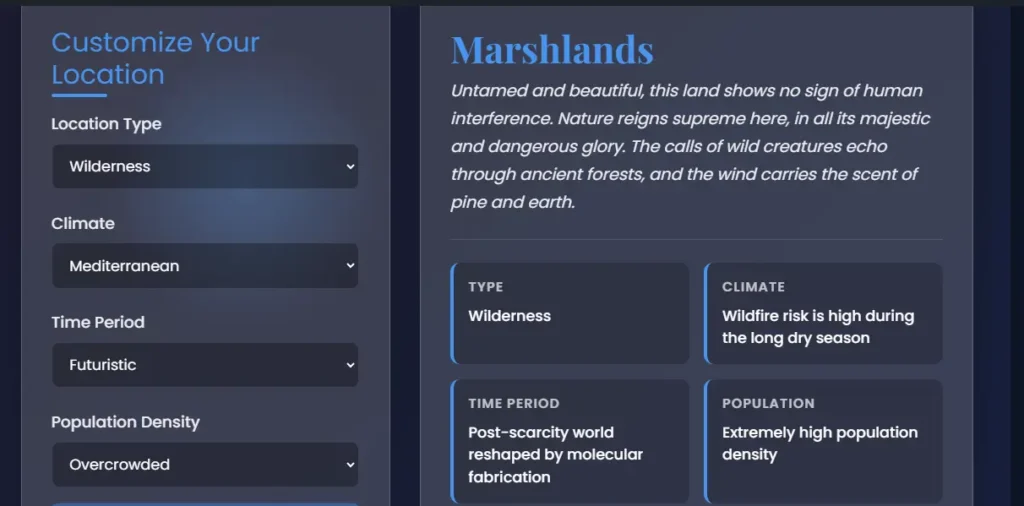
Most tools hand you a name and call it done. This one gives you a full setting card: location name, atmospheric prose description, location type, climate, time period, population density, notable features, and potential dangers. Everything you need is sitting there before you’ve typed a word.
Once your setting is ready, our Ambigram Generator can help you craft a visually striking name for your world, city, or faction that reads the same from multiple angles.
This tool is built for creative use — fiction writers, worldbuilders, tabletop players, and narrative designers. It generates fictional and genre-specific settings, not real-world GPS coordinates.
How to Use the Random Location Generator
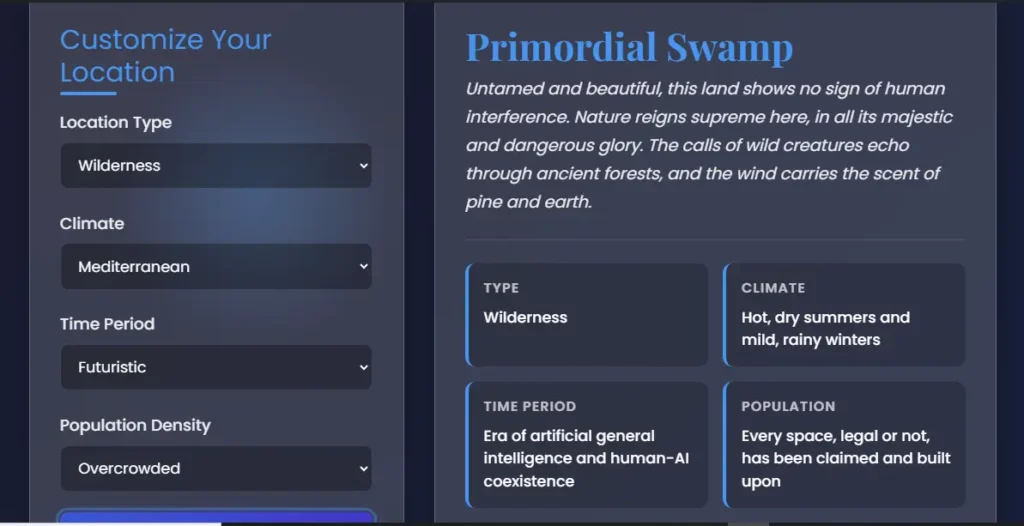
Four filters. Use all of them, some, or none at all — leaving everything open and seeing what comes out is a completely valid approach. Here’s what each filter does:
Select a Location Type
Pick from twelve categories: Urban, Rural, Wilderness, Coastal, Mountain, Fantasy, Sci-Fi, Historical, Underground, Arctic, or Desert. Leave it on “Any Type” to get the full range.
Choose a Climate
There are eight options here: Tropical, Arid, Temperate, Continental, Polar, Mediterranean, Monsoon, or Subarctic. Climate does more to shape the mood and feel of a setting than almost any other single choice.
Set a Time Period
— Nine eras to choose from, running from Prehistoric and Ancient all the way through Medieval, Industrial, Modern, Futuristic, Post-Apocalyptic, and Colonial. Mixing an unexpected era with a location type is often where the most interesting results come from.
Define Population Density
Six options that shape who (if anyone) actually lives there: Uninhabited, Sparse, Moderate, Dense, Overcrowded, or Nomadic.
Click “Generate Location
Hit the button, and you’ll immediately get a named setting, a prose description, all four detail dimensions, three notable features, and two potential dangers.
Copy, Browse History, or Generate Again
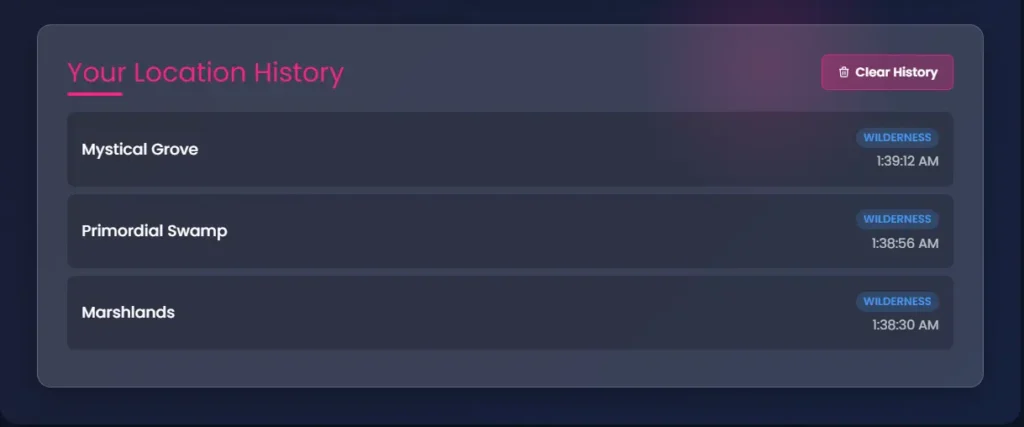
“Copy to Clipboard” gets you everything in one click. The History panel saves your last ten results automatically — you won’t lose a good one mid-session.
Pro tip: Almost right but not quite? Keep the filters as-is and hit “Generate Another.” Same parameters, reshuffled — you’ll often get a different angle on the same general idea.
What Is a Random Location Generator?
The phrase covers two pretty different things, so it’s worth knowing which type you’re looking at.
One kind gives you real coordinates — latitude, longitude, something you can paste into Google Maps. Good for research, geographic sampling, navigation games, that sort of thing.
This tool is the other kind. It generates fictional settings built for storytelling — no coordinates, no real map. Instead: atmosphere, social context, a historical era, and built-in dramatic possibilities.
When you get “Subarctic Underground Crystal Geode Chamber with Sparse Population in the Industrial Era,” that’s a story seed — not a coordinate.
The 12 Location Types: What the Generator Can Create
Twelve categories — real-world biomes, genre fiction, full speculation. Here’s what each one actually produces.
Real-World Environments
Urban settings cover a lot of ground — gleaming financial districts and university campuses at one end, ghost towns, refugee camps, and underground bazaars at the other. They’re a natural fit for crime fiction, contemporary drama, political thrillers, and character-driven stories. The urban category alone has over twenty distinct sub-locations, so you won’t see the same result twice for a while.
Rural settings span farmland, fishing villages, monasteries, mining towns, and border outposts. The pace here is slower and more intimate — well-suited to historical fiction, folk horror, cozy mysteries, and stories where community and tradition matter.
Wilderness settings are raw and untamed — ancient forests, volcanic regions, bioluminescent groves, carnivorous plant zones, sinkhole labyrinths. When a story needs to drop characters into nature on nature’s terms, this type gets there without pulling punches.
Coastal settings range from busy port cities and pirate coves to mangrove villages, kelp forest diving sites, and fog-shrouded peninsulas. The sea brings trade, movement, danger, and mystery all at once — which makes coastal locations some of the most versatile starting points for adventure writing and nautical campaigns.
Mountain settings are about height and isolation. Cloud cities, glacier research stations, rope bridge settlements, and storm-caller summits all push characters to their physical and psychological edge. These work well for epic storytelling or any story where the landscape itself needs to mean something.
Arctic settings have a particular kind of extremity — the permanent cold, the polar night, the aurora overhead, the frozen ship graveyard sitting half-buried in ice. These environments are about endurance, and about being trapped in close quarters with forces you can’t outrun or outthink.
Desert settings live in the tension between beauty and brutality. Sand dune cities, oasis towns, caravan crossroads, and wind-carved cave dwellings all follow the same logic: water determines everything, and every other detail in the setting follows from where water can or can’t be found.
Fictional and Speculative Environments
Fantasy is where the generator really comes into its own as a creative tool. Elven cities, dragon lairs, wizard towers, feywild meadows, undead necropolises — these settings are built for DnD campaigns, immersive fiction, and any story where magic is part of how the world works
Sci-Fi locations go in the opposite direction entirely. Space stations, generation ships, AI hive mind hubs, bio-dome settlements, and wormhole transit stations cover the full stretch of speculative world-building, from near-future Earth to far-future space opera.
Historical locations pull from across human civilization — Roman cities, Viking settlements, Silk Road trading posts, feudal Japanese castle towns, Ottoman bazaars, and Mayan observatory cities. Each one carries the weight of a real era, but filtered through creative possibility rather than strict accuracy. If a Historical location sparks your imagination, our Medieval Name Generator gives you authentic period-accurate names for the rulers, settlements, and factions that bring it to life.
Underground settings are a staple of dungeon-crawl campaigns, but they’re also their own distinct kind of world. Cave cities, crystal geode chambers, ancient catacombs, troll markets, and root network cities all run by different rules — no sunlight, compressed geography, and the permanent weight of everything above pressing down.
Who Uses a Random Location Generator?
There’s a clear core audience here, but the tool gets used in ways you might not expect.
Fiction Writers and Authors
Setting block is its own specific kind of stuck — you know the story, you just can’t figure out where it happens. This gives you an anchor: a named place with atmosphere, history, and dramatic potential already in it. It doesn’t write anything for you. It just gives you a place to start from. Pair it with our Random Birthday Generator to give the characters who inhabit that setting a concrete birthday, age, and backstory starting point.
It also catches you when you’re repeating yourself. A few scenes in, it’s easy to realize all your settings look the same without having meant for that to happen. A fresh batch shakes it loose. Short story writers run into this as often as novelists.
Dungeon Masters and Tabletop RPG Players
Players go off-script. Every session. Suddenly there’s a location that needs to exist in the next thirty seconds and nothing was planned. This tool is fast enough to use right then, and detailed enough to actually play in. The notable features and potential dangers do a lot of the work — “ley line convergence,” “resonant crystal formations,” “mind-controlling parasites,” “blood feuds between factions.” That’s not set dressing. That’s a whole session.
And once you know the setting, our Villain Name Generator helps you populate it with an antagonist powerful enough to match the danger it promises.”
Worldbuilders and Tabletop Game Designers
A game world needs dozens of locations. Building them all from scratch takes forever. Running the generator across different types and climates in one sitting builds out a library fast — and gives you actual material to react to instead of a blank page.
It also works as an accidental checklist. Results clustering around the same biomes and eras means your world has gaps. The history panel makes that obvious.
Students and Workshop Writers
The best writing exercises put you somewhere uncomfortable. Nobody chooses “Monsoon-climate Underground Fungal Colony with Nomadic Population in the Post-Apocalyptic Era” on their own — and that’s the point. Being forced to answer questions about a setting you’d never have picked is where writing gets genuinely surprising, even to you.
Screenwriters and Narrative Designers
Scripts and episodic work need locations that feel distinct from each other. Running a batch and scanning the history panel side by side is a quick way to build a varied bank without repetition creeping in.
Key Features of This Random Location Generator
Coastal Medieval Town” isn’t a setting — it’s a label. This was built to go past that. Here’s what you actually get:
- 12 Location Types covering real-world biomes, historical periods, and genre fiction environments — the widest range available in a single free tool
- 8 Climate Options that define the sensory and emotional texture of each generated environment
- 9 Time Periods from Prehistoric to Post-Apocalyptic, enabling genre flexibility, no coordinate-based tool can match
- 6 Population Density Levels — from Uninhabited wilderness to Nomadic cultures to Overcrowded urban sprawl
- Full Atmospheric Prose Descriptions are included with every result, not just a label
- 6-Dimension Detail Cards — every result shows Type, Climate, Era, Population, Notable Features, and Potential Dangers
- The History Panel holds onto your ten most recent results for easy comparison
- One-Click Clipboard Export for immediate use in any writing or note-taking software
- Completely Free with no usage limits and no sign-up required — runs in any modern browser without installation
If you’re building a formal world document or RPG sourcebook, our Superscript Generator lets you add footnotes and reference markers to your exported text with a single click.
The generator is fully responsive and works on mobile browsers. Open it on any device and it is ready to use immediately — no download required.
Creative Setting Generator vs. Geographic Coordinate Tools
Here’s the honest version of what this tool does and doesn’t do.
Coordinate tools give you a real point on Earth — latitude, longitude, something you can open in Google Maps. If you need a real-world spot, those are the right tools.
This tool makes something else. A “Tropical Coastal Pirate Cove with Dense Population in the Colonial Era” doesn’t exist on any map — it’s a creative prompt with enough detail to start writing from right away.
Need real coordinates? Use a coordinate tool. Figuring out where your story or campaign is set? This is it.
How to Get the Most Out of Every Generated Setting
The generator handles the first part. A few habits make the results a lot more useful once they’re in front of you.
Treat Every Result as a Starting Prompt
A result is a starting document, not a finished product. “An Underground Bioluminescent Cavern with Tropical Climate and Overcrowded Population in the Colonial Era” is the setup. The questions are yours: Who settled here? What do they eat without sunlight? Who got displaced when they moved in? The tool raises the questions. You answer them.
If you’re not sure who to put in that setting, our Random Character Trait Generator gives you a fully fleshed personality to drop straight into the world you just built.
Use Multiple Generations to Build a Setting Library
Generate five or ten in one sitting and look at the history panel as a whole. A sparse arctic outpost, a dense medieval city, a nomadic desert caravan culture — that’s already the bones of a world with real range. The history panel ends up being a rough first draft of your world’s geography, almost without trying.
You can even copy your generated results and run them through our Word Cloud Generator to visually spot which themes, climates, and location types are dominating your world — and where the gaps are.
Let the Potential Dangers Field Drive Plot
Most people skim the Potential Dangers field. Don’t. “Sentient weather patterns” in a coastal fishing village. “Unstable magic fields” near a medieval observatory. “Blood feuds between factions” in an overcrowded Colonial trading post. Those aren’t decorations — they’re plots. Whole sessions. Pick one and run with it.
Match Climate to Emotional Tone
Climate sets a mood, not just a temperature. Polar means isolation and people forced together with nowhere to escape. Mediterranean suggests comfort with something uneasy under the surface. Monsoon means cycles — things built, things lost. Match the climate to what a scene needs emotionally and the setting stops being backdrop and starts doing actual work.
Use It to Break Creative Patterns
Use it mid-project, not just at the start. Run a fresh batch and compare it to what you’ve already written. If everything looks familiar, the draft has started repeating itself. New options sitting next to old ones make that obvious and give you something to break out of it with. New settings also work as connective tissue — distinct environments between scenes that make readers feel like the story is actually moving.
Frequently Asked Questions
Is the Random Location Generator completely free?
Yes — completely free, no account or subscription needed. Just open it in any browser and start generating. There are no daily limits, no locked features, and no hidden costs.
Can this tool be used for DnD and tabletop RPG sessions?
Absolutely. Dungeon masters are one of the main audiences this tool was made for. Fantasy and Historical location types, combined with population and time period filters, produce setting cards that slot straight into most RPG systems. The Notable Features and Potential Dangers fields work as built-in encounter hooks and plot seeds.
Does it generate real-world addresses or GPS coordinates?
No. This is a creative setting generator, not a coordinate tool. It produces fictional, genre-specific settings for storytelling, world-building, and tabletop play. For real-world coordinates or a navigable address, you’d want something like a Google Maps-based generator instead.
Is there an app to download, or does it work in the browser?
It runs directly in any modern browser — nothing to install. It’s fully responsive and works on phones, tablets, and desktops. Open it and it’s ready to go.
Can I generate locations near me or restricted to areas on land?
This generator creates fictional settings, not real-world positions. It doesn’t filter by proximity or whether a location exists on land. For real-world geographic generation, coordinate-based tools are what you want. For creative setting generation — this is it.
What makes this different from other random location generators online?
Most tools give you a name or a coordinate and leave the rest to you. This gives you a full setting card — prose, six detail dimensions, notable features, potential dangers — built for actual creative work. And twelve location types, eight climates, nine time periods, and six population levels is far more variety than anything comparable that’s free.
How many locations can I generate, and are the results saved?
There’s no limit. The history panel automatically stores your ten most recent results, and the clipboard export lets you grab any result instantly. For anything you want to keep long-term, pasting into a notes document is the way to go.
Is this useful for stepping stones in a larger world-building project?
Yes. Generate across biomes and eras, see what sparks, develop the ones worth building out. The output is varied enough that each stepping stone feels genuinely different from the last — which is what makes a world feel like a real place rather than the same location dressed up differently.
Start Building Your World Right Now
The hardest question in any story or campaign is usually the first: where does this happen? Get that answer and everything else has somewhere to build from.
This tool handles that first step. It’s free, it’s fast, and it was built for people who need a real creative starting point — not a coordinate. New campaign, fresh chapter, just need to know where the story is set — it’s ready when you are.
Scroll back up, set the filters, and hit Generate. The world is waiting.