
Introduction
Staring at a blank page, waiting for a character to materialize out of thin air—every writer knows this special kind of torture. The protagonist feels flat. The villain lacks depth. And that quirky sidekick? They’re starting to look suspiciously like the quirky sidekick from the last story.
Here’s the thing about creating memorable characters: it shouldn’t feel like excavating fossils with a toothbrush. Whether crafting a novel, running a D&D campaign, or designing video game NPCs, the challenge stays the same—building people who feel genuinely real.
A random character trait generator can be a writer’s secret weapon. But there’s a catch. Most generators just throw random adjectives at the wall and call it done. The good ones? They dig into the messy psychological tensions that make characters actually interesting.
This tool works for writers, game masters, screenwriters, and anyone populating creative worlds with believable people. It’s especially handy when deadlines loom e.g. “especially useful during National Novel Writing Month (NaNoWriMo)”, inspiration vanishes, or a project needs a dozen distinct personalities by Friday.
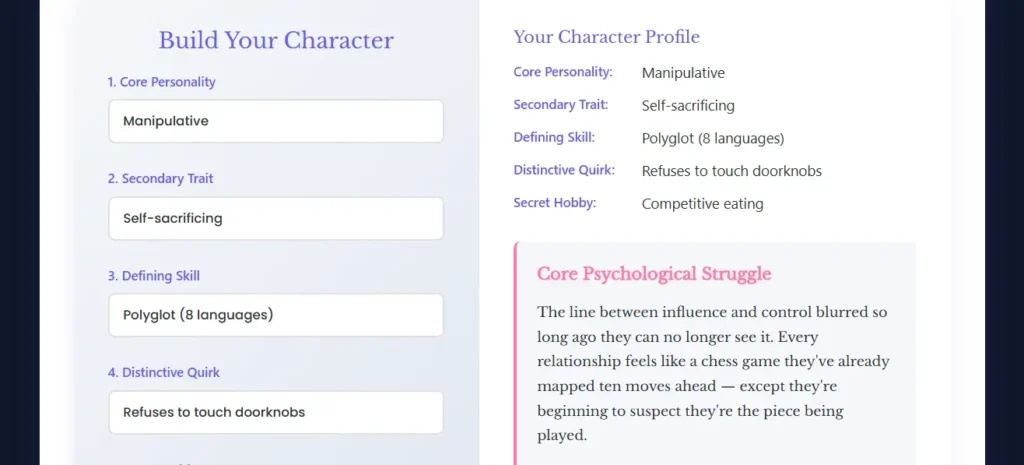
How To Use This Random Character Trait Generator Tool
The process unfolds in five steps, each adding layers of complexity
Select Core Personality
Choose the dominant trait defining their worldview. Options span from ambitious to stoic, rebellious to pragmatic. This choice colors everything that follows.
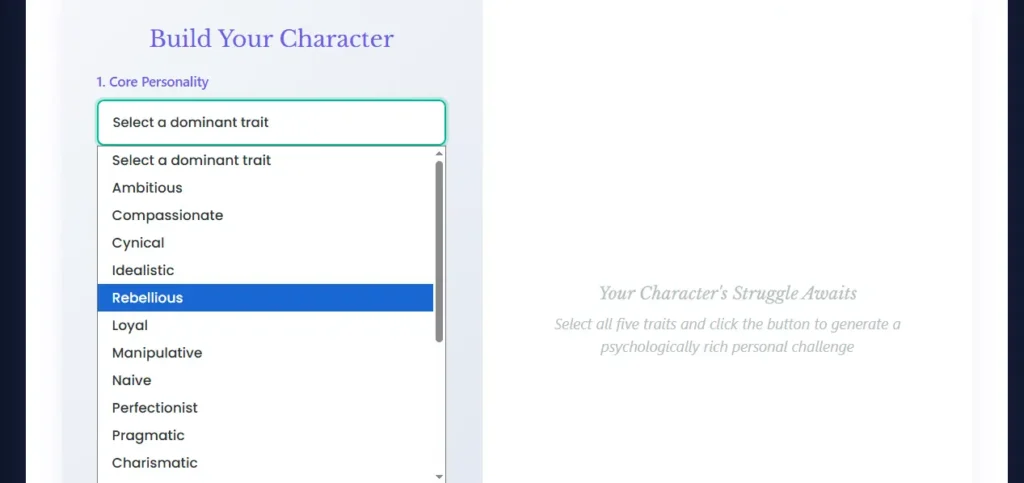
Pick Secondary Trait
Add the layer that creates depth and contradiction. Charismatic but simultaneously a lone wolf? Analytical yet secretly a hopeless romantic? These tensions make personalities compelling
Choose Defining Skill
Skills provide capability but also burden. The human lie detector never experiences comfortable social interaction. The escape artist can never feel truly trapped—or truly secure.
Add Distinctive Quirk
Small behavioral details readers remember. These often started as coping mechanisms but evolved into something more compulsive
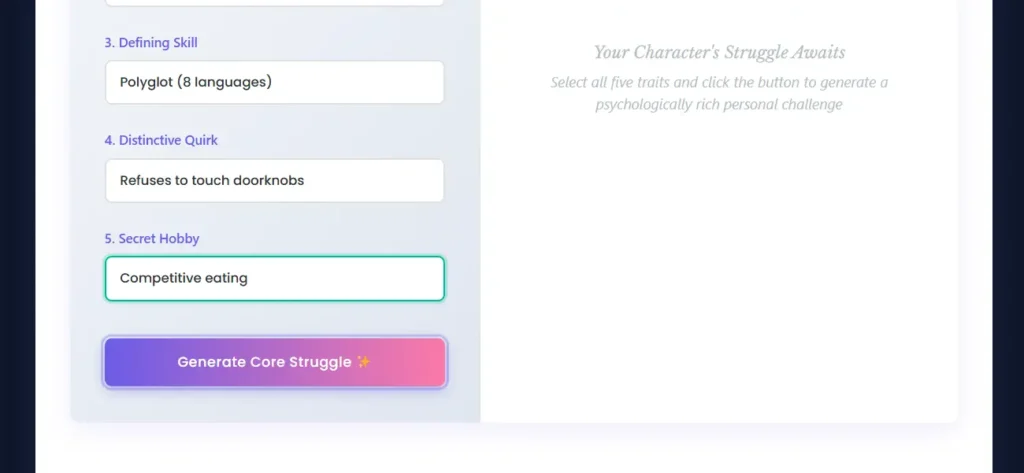
Select Secret Hobby
Everyone has private passions misaligned with their public image. The corporate lawyer practicing graffiti. The sunshine teacher obsessed with true crime.
The Game-Changer: Psychological Struggles
Here’s where this tool separates from basic generators. After selecting traits, clicking generate produces a contextual psychological struggle tying everything together.
This isn’t random conflict assignment. The tool analyzes trait combinations and generates struggles emerging naturally from those specific characteristics. An ambitious master manipulator faces different demons than a compassionate human lie detector.
These struggles explain how traits create authentic internal conflict—the psychological costs of abilities, the isolation of excellence, the price of contradiction.
What Makes Characters Feel Real?
A character trait generator produces random combinations of personality characteristics, skills, quirks, and defining features. Think of it as a creativity defibrillator—shocking writers out of their usual patterns and forcing unexpected combinations they’d never choose deliberately.
These tools pull from carefully curated databases of character attributes “ — e.g., “drawing from established TV Tropes character archetypes“. Click “generate,” and algorithms randomly select traits, creating unique combinations. The magic lives in those weird pairings—the master chef who chronically lies, or the empathetic person who can’t make eye contact.
The Building Blocks of Personality
Real depth comes from layering different types of traits. Here’s how they stack:
Core Personality Traits shape worldview “ — e.g., “rooted in frameworks like Myers-Briggs personality types“. An ambitious character sees opportunities where a compassionate one sees people who need help. These traits drive every decision.
Secondary Traits create contradiction. Someone charismatic on the surface but secretly insecure underneath—that tension makes them human. Nobody’s perfectly consistent.
Skills and Abilities define exceptional capabilities. The polyglot who speaks eight languages, or the human lie detector who reads micro-expressions. These gifts isolate as much as they empower.
Quirks stick in readers’ minds. Arriving exactly seven minutes early, organizing by color, talking to inanimate objects—these details make characters instantly recognizable.
Hobbies and Interests reveal hidden depths. The tax attorney who practices urban exploration. The kindergarten teacher is collecting vintage poison bottles. These contradictions feel authentically human.
Why Random Actually Works
Writers fall into ruts. They unconsciously recreate the same character with minor tweaks. Random generation disrupts those patterns, forcing consideration of combinations that would never surface otherwise.
There’s also paralysis from infinite choice. When everything’s possible, many creators freeze. Random generation cuts through that, providing a concrete starting point. It’s easier to refine an existing concept than conjure something from absolute nothing.
Best of all? Unexpected pairings spark creative connections that lead to truly original characters. When the generator pairs “perfectionist” with “chaotic organizer,” suddenly there’s a fascinating contradiction begging exploration.
What Makes This Random Trait Generator Unique
Most character generators stop at trait assignment: brave, intelligent, and fears heights. Done. They won’t explain how these elements create psychological tension or inform character development.
This generator examines how traits interact. Select “cynical” and “ghost hunting,” and the generated struggle explores that contradiction—a rational mind dismissing the supernatural while irresistibly drawn to haunted places.
The five-category system prevents making characters too consistent. Real people contain contradictions. This approach builds those contradictions into the foundation.
Smart combination recognition means specific pairings trigger unique struggles. “Ambitious + master manipulator” generates a different psychology than “ambitious + medical prodigy.” Fallback mechanisms ensure every combination produces meaningful conflict.
Who Benefits and How
Fiction Writers
Novelists populate narratives with distinct personalities. The psychological struggle feature appeals to literary fiction writers prioritizing internal development over plot.
Many generate multiple characters for ensembles, ensuring each supporting character has a distinct voice and motivation. The antagonist development particularly shines here—villains feel motivated rather than simply evil.
Game Masters and RPG Players
Dungeon Masters need endless NPCs to feel distinct, combined with our medieval name generator for full immersion. Generated personalities make improvisation natural. That blacksmith becomes a secretly insecure perfectionist, use our warrior name generator to complete the profile,” organizing everything by color—suddenly a memorable character moment instead of just a transaction. Tools like Roll20 NPC generator complement this approach
Players creating characters avoid defaulting to familiar patterns. The psychological struggle gives built-in motivation driving role-playing decisions.
Screenwriters and Playwrights
Script writers need internal lives externalized through action. Generated quirks and hobbies translate beautifully into visual storytelling—behavioral details actors can embody.
Television writers maintaining ensemble diversity benefit hugely. Eight regular characters easily blur together without distinct trait profiles ensuring everyone has unique voice and conflicts.
Game Developers
Narrative-heavy games need NPC populations with distinct personalities. Quest design improves when quest-givers have clear motivations rooted in struggles—missions feel meaningful rather than arbitrary fetch quests.
Creative Writing Students
Students analyze generated characters as case studies in how personality creates organic conflict. Portfolio development accelerates with quick starting points for character studies.
Understanding Internal Conflict
The difference between forgettable and memorable characters almost always comes down to internal struggle. External obstacles drive the plot, but internal conflicts drive emotional resonance.
Readers don’t just want to know what happens—they want to know what it means. Internal conflict provides that meaning. Two characters facing the same obstacle respond differently based on their struggles, and those responses cost them differently.
Types of Psychological Struggles
Fear-based conflicts stem from what terrifies characters most. The ambitious person fears insignificance. The compassionate person fears failing someone. These often stem from trauma or deeply held beliefs.
Identity conflicts emerge when who someone is clashes with who they pretend to be. The master manipulator wearing masks so long they’ve forgotten their true face. These struggles question the fundamental nature of the self.
Moral dilemmas pit values against desires. The human lie detector who can expose truth but knows that truth devastates someone they care about. No clean resolution exists—psychologically rich territory.
Relationship struggles explore tension between connection and self-protection. Characters desperately wanting intimacy, but whose traits push people away.
How Traits Create Real Conflict
The generator recognizes how specific traits naturally create specific tensions:
An ambitious master manipulator climbs high through deception. Their struggle isn’t continued success—it’s whether success through manipulation has meaning. Surrounded by people, trusting none.
A compassionate human lie detector sees everyone’s pain and every self-deceptive lie. Their gift becomes a curse because ignorance would be mercy, but they can never unknow what they perceive.
The cynical ghost hunter embodies a walking contradiction. The rational mind dismisses the supernatural yet is compelled toward haunted places. Each investigation tests their skepticism. They dread finding proof because it would shatter their worldview.
These aren’t random struggles assigned randomly. They’re organic explorations of how those characteristics create genuine psychological pressure.
Getting the Most from Generated Characters
Experiment Freely
Generate multiple combinations without judging, and visualize recurring themes using our free word cloud generator. Sometimes the tenth generation sparks the winning idea. Mix elements from different generations for something even better.
For ensembles, generate all characters in one session and compare results. This ensures diversity while revealing potential dynamics. Friction between conflicting traits across characters creates compelling relationships.
Don’t immediately discard weird results. Uncomfortable pairings often lead to the most original characters.
Build on the Foundation
Generated traits are starting points, not complete definitions. “Ambitious” could mean career success, social justice, artistic recognition, or revenge. Direction matters as much as trait.
Develop backstories explaining trait formation. Why collect teeth? What childhood experience led to organizing by color? Origin stories transform quirks from random affectations into meaningful character elements.
Consider how traits manifest differently in context. The manipulative character might be ruthless in business but vulnerable with family. People contain contradictions.
Avoid Common Mistakes
The biggest pitfall? Treating generated traits as complete characters. Traits provide a personality framework, but characters need goals, relationships, values—all the messy details making people real.
Another trap: making every character equally quirky. Sometimes the conventional character becomes interesting precisely because they’re surrounded by eccentrics. Balance matters.
Don’t force traits that genuinely don’t fit. The tool serves the creative process, not the other way around.
Finally, traits should feel natural, not like checklist demonstrations. Integration beats exhibition.
Advanced Techniques Worth Exploring
Layering Traits Over Time
Real people reveal different aspects gradually. The cynical character eventually shows vulnerability. The confident one reveals deep insecurities to close friends.
Consider which traits appear publicly versus privately. The master manipulator might be smooth and charming socially but anxious and self-doubting alone
Creating Dynamic Relationships
Characters become more interesting in relation to each other. Generate traits for multiple characters, then examine how personalities interact. Complementary traits create comfort while conflicting traits generate tension.
Protagonist-antagonist relationships often work best with unexpected mirroring. Both might be ambitious, but one pursues goals through collaboration while the other manipulates.
Genre-Specific Applications
- Thriller/Mystery — Focus on traits creating unreliable narrators or hidden agendas.
- Fantasy — Balance magical abilities with psychological realism, try pairing traits with our monk name generator“. Generated struggles ground fantastical elements in authentic emotion.
- Romance — Use trait compatibility and conflict to create chemistry. Complementary traits draw characters together while conflicts create obstacles.
- Horror — Traits become tools for creating dread. The character never making eye contact won’t notice the thing approaching peripherally
Frequently Asked Questions
Is this generator free?
Yes, completely free with unlimited generations. No hidden fees or restrictions.
Do I need to credit the generator?
No attribution necessary. Generated characters are yours to use freely.
Can I use these for commercial projects?
Absolutely. Use generated characters in novels, films, games, or any project without licensing restrictions
How does psychological struggle generation work?
The tool analyzes trait combinations and generates contextual struggles based on how those characteristics interact psychologically. Some combinations trigger pre-written struggles while the system constructs unique conflicts for others.
Should I use all five generated traits?
Use whatever serves the story. Some characters work with all five prominently displayed, others function better with certain traits kept subtle.
How do I avoid stereotypes?
Add specificity beyond traits. Instead of just “ambitious,” explore what they’re ambitious about and why. Include personal history and specific goals, making the character individual rather than type.
Can I generate multiple characters for ensembles?
Yes, highly recommended. Generate traits for each cast member separately, then review together ensuring distinct voices.
What if I don’t like the generated struggle?
Use it as inspiration and modify to fit your vision. Or generate different trait combinations to see what other struggles emerge.
Does the generator save profiles?
Currently no save functionality exists. Copy favorite results into your own notes or writing software.
What makes this different from other generators?
While many generators list random traits, this tool generates contextual psychological struggles explaining how traits create internal conflict—examining the price of abilities, burden of contradictions, and isolation of exceptional characteristics.
How do I use generated characters for RPGs?
Traits translate beautifully into character motivations and role-playing decisions. Use psychological struggles to inform reactions in different situations.
Can I modify the generated results?
Absolutely. Traits serve as springboards, not rigid requirements. Feel free to modify, expand, or reinterpret anything to fit specific needs.
Start Creating Today
Character development doesn’t have to be the hardest part of creating. With the right approach, building psychologically rich personalities becomes not just easier but genuinely enjoyable.
This generator offers something most don’t: genuine psychological depth. It examines how traits interact to create authentic internal conflicts—struggles making characters feel human rather than constructed.
Whether writing a first novel, running a campaign, developing a game, or working on any project needing compelling personalities, this tool provides a foundation to build on. It breaks creative blocks, introduces unexpected combinations, and saves hours typically spent wondering who these characters should be.
The generator works best with flexibility and curiosity. Generate multiple combinations. Mix and match results. Use traits as springboards rather than limitations. The goal isn’t replacing creative judgment but enhancing it—providing that crucial spark, transforming vague concepts into something specific, complex, and memorable.
Every great story begins with great characters. The ones readers remember. The ones players talk about years later. The ones feeling so real they could walk off the page. Once your character takes shape, give them a visually striking signature with our Ambigram generator.”
Those characters start here. Five trait categories, one generate button. Someone willing to embrace unexpected combinations and explore uncomfortable contradictions. Creators ready to dig into psychological depth rather than settle for surface description.
Try the generator. Select five intriguing traits. Click generate and see what psychological struggle emerges. Then take that foundation and build someone extraordinary—someone flawed, complex, and utterly unforgettable.
The blank page is waiting. The generator is ready. And somewhere in those random combinations, the next great character waits to be discovered.